The 90 Seconds Before Anyone Gives an Order
Substack post CNT-005. Structure per cc02-standards/CONTENT-STANDARD.md. Target 600 to 1200 words. Derives from the atom listed in inputs; body here is the publishable long-form text.
1. Hook
75 to 125 words. Cold open, present tense, in medias res on the story beat. No framework name yet.
The vehicle ahead stops rolling. Not slows - stops, dead, in the middle of the route, with two more vehicles behind it and nowhere to go. Nobody on the team holds a meeting to figure out what happens next. Someone is already calling a drill name over the radio before the car has finished rocking on its shocks. Bodies close around the person in the middle seat in the same second, not because anyone gave an order, but because the order was never going to come in time. Nobody in that circle is thinking. That is not a failure. That is the entire point.
2. Field Note
150 to 250 words. The war story: what the absence or presence of a system cost or saved. Narrative, not doctrine.
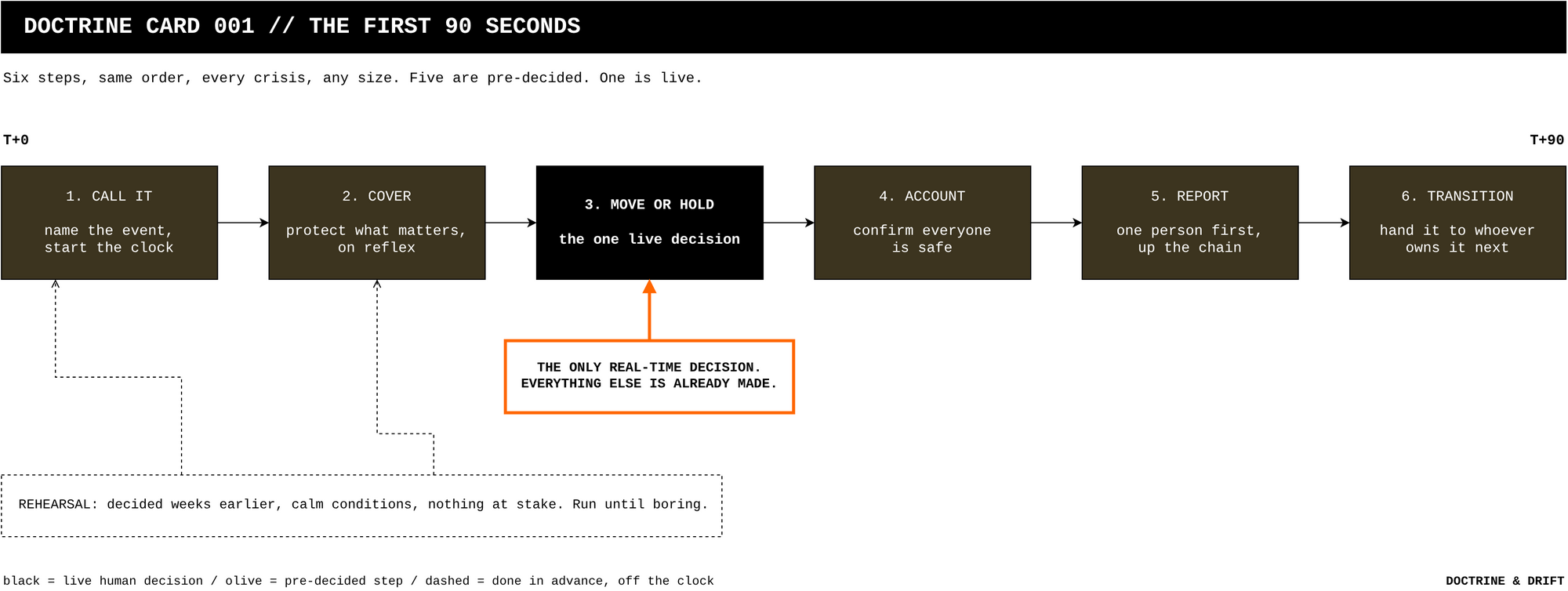
Protective teams rehearse a stalled-vehicle drill until it stops feeling like an event. In a typical run, the lead vehicle loses mobility without warning - mechanical failure, an obstruction, it does not matter which. What matters is what happens in the next several seconds, and none of it is invented on the spot. The nearest operator calls the drill name and a location before the vehicle has stopped rocking. Cover forms on reflex, ahead of any discussion. The team lead reads three options in the time it takes to exhale - push through, reverse out, or shift the principal to a second vehicle - and calls one, and nobody argues with the call while it is happening. Everyone is confirmed safe within the same breath the group starts moving toward the alternate route, and word goes up the chain while they are already rolling. Stall to moving again: under two minutes, most of it silent. Ask any of them afterward what they decided in the moment and they will struggle to answer. What they will describe, in detail, is a parking lot weeks earlier, cones for vehicles, nothing at stake, running the same ninety seconds until it stopped requiring thought.
3. The System
75 to 150 words plus one embedded diagram. Name the framework, show the diagram, walk it in five sentences or fewer.
The behavior underneath that drill - and every drill like it - is a six-step sequence: call it, cover, move or hold, account, report, transition. Calling it names the event out loud and starts the clock, so everyone within earshot knows which drill just began. Cover happens on reflex, not by committee. Move or hold is the sequence’s one live decision, and it is pre-assigned by drill so nobody has to invent a strategy while adrenaline is running the show. Account, report, and transition close the loop - confirm everyone is safe, tell the chain what happened, then hand the situation to whoever owns it next.
4. Generalization
150 to 250 words. The explicit bridge into a domain the reader lives in. Mandatory; this section is the value proposition.
You will not run a motorcade, but you will get the call that the position was eliminated, or the message that a test result came back flagged, or your phone lighting up at 2 a.m. with your kid’s name on the screen. The six-step shape holds at any scale, because the problem it solves - no time to think, and thinking is exactly what panic ruins - is the same problem everywhere. Call it: say what is happening in one plain sentence instead of letting it sit as formless dread. “I have been laid off” starts the clock on everything that follows; a feeling with no name just sits there and grows. Cover: protect what matters most before you touch anything else - the rent money stays untouched, the big question waits an hour. Move or hold: decide in advance whether your default is to act (start making calls today) or to hold (sleep on it, call tomorrow), so adrenaline never gets to write your strategy for you. Account: check who else this touches - a partner, a kid, your own state - before you tell another soul. Report: call the one person who needs to know first, not a group text broadcast to everyone at once. Transition: hand the problem to whoever owns the next step - a recruiter, a doctor, or a full night of sleep.
5. One Action
50 to 100 words. One concrete action in imperative doctrine voice, then the cross-platform CTA.
Pick the one crisis most likely to find you this year and write your own six-line drill card today, one sentence per step: call it, cover, move or hold, account, report, transition. Read it once, out loud, right now - that reading is the rehearsal, and it is the only version of preparation that actually works under stress. This is post one of THE ADVANCE. Subscribe for the next card, and reply with the crisis you drilled for - the best ones become future cards.
END OF POST
Connected cards
- Builds on: The 90 Seconds Before Anyone Gives an Order